
Goal 2: Understand the essential nature of information and its relevance to our diverse society.
Outcome 2A. Describe various definitions and concepts of information.
LIS 703 (Organization of Knowledge) is such a fun class for a library student. Finally, a space to do the work I expected from library school. This artifact is my cataloging course final exam, which includes examples of not just cataloging, but shows understanding information at various entity levels. This exam, which I received an A on, proves I understand FRBR, RDA and ISBD punctuation, how to use the RDA toolkit, and fundamental cataloging concepts.
Outcome 2B. Explain the impact of information policies on intellectual freedom, access, literacy,
information behavior, and other aspects of library and information science.
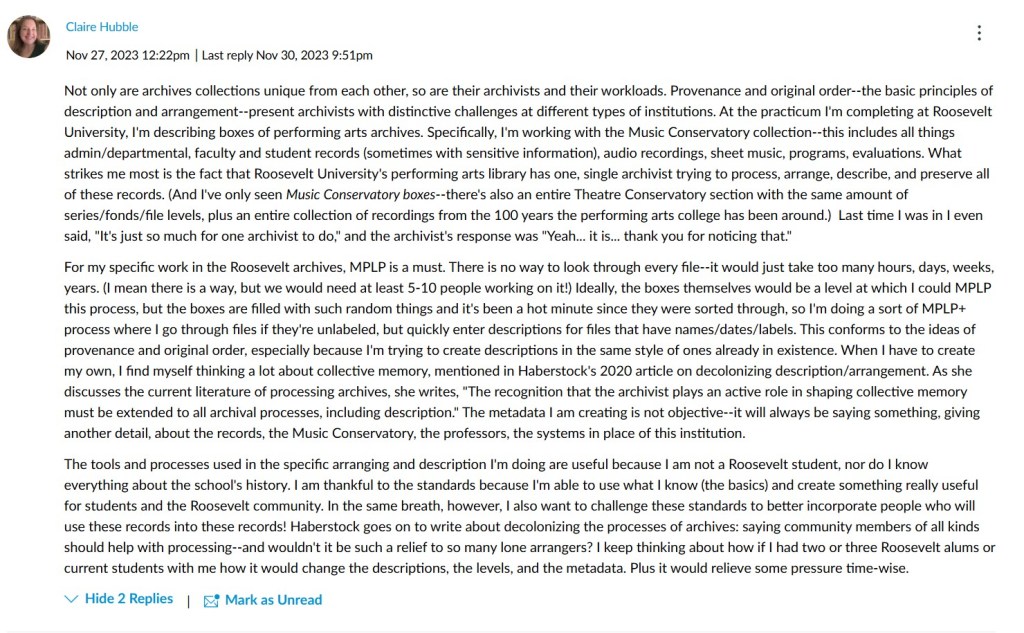
This discussion board post comes from LIS 775 (Intro to Archival Principles) and is about real-world implementation of the archival pseudo-policy MPLP, or, more product, less process. In these threads, we were to “describe two ways in which the current process of arrangement and description underscores the uniqueness of archival records and the challenges to developing standards.” I referenced my work at the Roosevelt University archives to give specific examples of how MPLP can be helpful (and unhelpful) when processing archives.
Outcome 2C. Develop appropriate responses to assessed information needs within diverse
communities/organizations.
My reference email response below was originally created in my LIS 702 (Facilitating User Learning and Information Needs), all about how to successfully complete a reference interaction. This assignment is unique because it required me to write out every step of answering a reference question. The actual email response I crafted can be found on the last two pages of the assignment.
 Claire in the Library
