
Reflection Essay
Click here to download this essay.
Claire Hubble
March 2025
I began the SOIS Master’s in Library and Information Science program in Fall 2022, two years after graduating from Marymount Manhattan College with a Bachelor’s degree in Theatre Studies and Art History. This was also two years after a global pandemic shut down every theatre in the country, leaving this dramaturg without a place to begin a niche yet rewarding career. In 2020, I was afraid live theatre would never return to normal and that play libraries and theatre institutions would cease to exist. I sat in this feeling for a couple of years while working a few horrible jobs (serving frappuccinos to unmasked drive thru customers and helping grandmas find new watercolor sets at the art store), but felt disgruntled and mentally unsatisfied.
As I was searching for a fulfilling profession, I reflected on my past jobs and what I truly valued in life. Before the pandemic, I worked at the New York Public Library (NYPL) as an undergraduate, General Research Division page. This was a position I applied for in 2018 because of my love of books and reading, and quickly became one of the best positions I have ever held. Retrieving research materials and shelf reading was all I knew about library work, but I very quickly grasped the radical nature of these institutions as I assisted patrons of all kinds: tourists, homeless people, old people, students of all ages, academics, authors, and of course, people with too much free time on their hands.
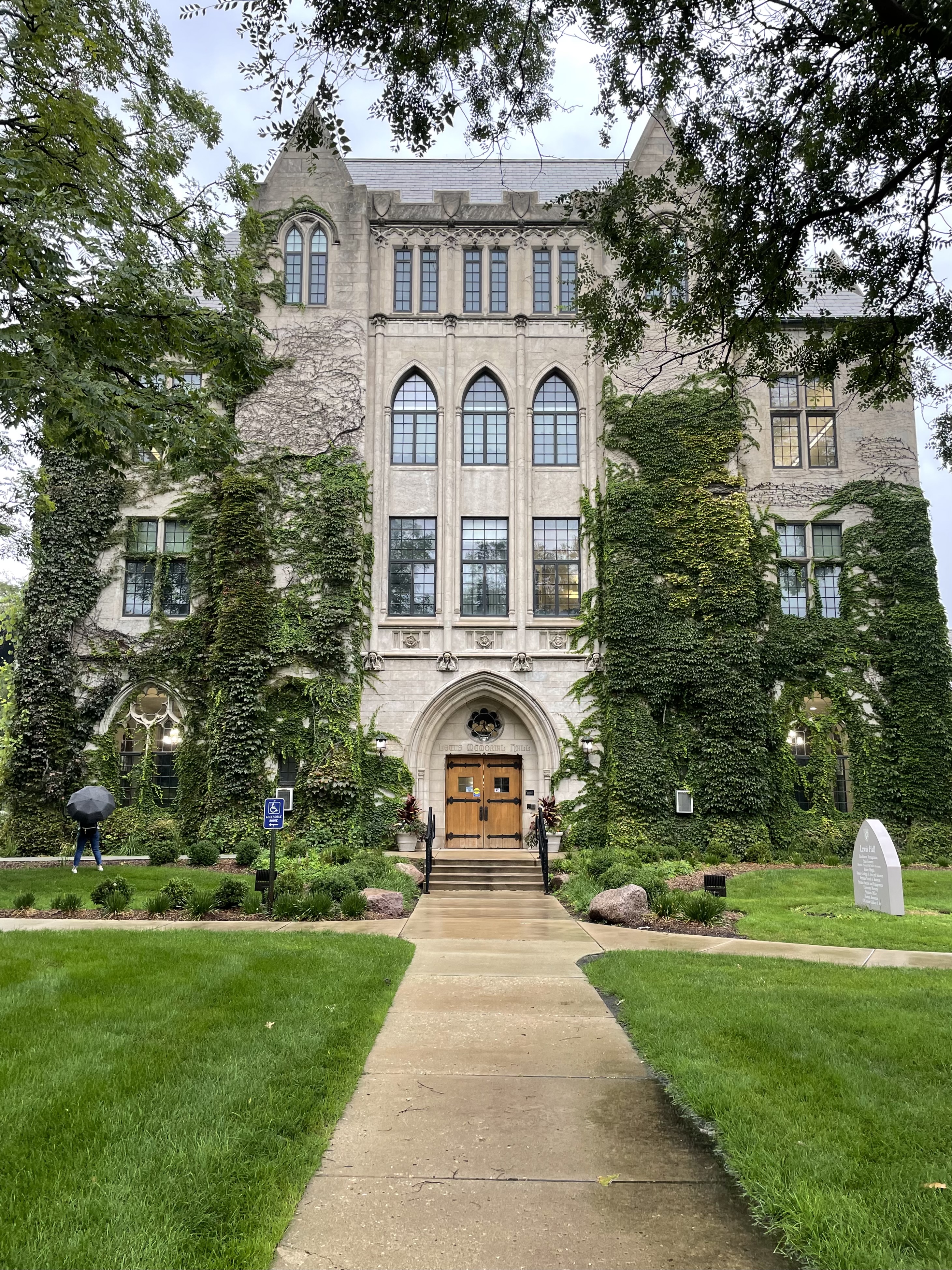
Photo of Lewis Memorial Hall, Dominican University taken by Claire.
As a work-oriented individual, I get a lot of joy out of completing tasks on time, having a positive relationship with the people I am employed alongside, and exerting a lot of energy as I work through projects. As someone who is living in an era in which we can so visibly see the effects late stage capitalism has on enjoying life, I attempt to be conscious of the fact that I have been consistently exploited at every job I have ever had. In her (2021) book, Work Won’t Love You Back, Sarah Jaffe uses interviews with people from a range of professions, including service-oriented positions such as teachers and nurses, to emphasize the collective action and organization needed during the fall of neoliberalism. Many of her interviews highlight that workers do not love their work, but the community that work creates for them in their co-workers and other people in their lives. In her conclusion chapter, Jaffe–focused on her audience envisioning a world without, or at least outside of, capitalism–explains workers need a reclamation of public space in the spirit of liberation. I think this is why talking about workers, labor, capital, and libraries within the same conversation can be so complicated. For me, librarianship is inevitably intertwined with the idea that all people can receive the resources they need for free, but libraries do not exist in a world without capitalism, a point which has been made clear in the many courses I have taken during this program.
I pride myself on giving maximum effort to most assignments and schoolwork I complete, from discussion boards to grant proposals to presentations to meetings with professors and colleagues. When I initially applied for graduate school, I was very excited to once again be academically challenged. Over the first few courses of this MLIS program, though, I realized that library school was different from what I was expecting graduate school to be. Instead of a more intense version of a four-year program, I was learning an entirely different set of skills, processes, and way of thinking. Though I was building on skills I first acquired at the undergraduate level, I was expecting more struggle in the work. I have written numerous papers, read thousands of pages of academic journals, and ethically squabled with the profession’s biggest issues. I think I have done a wonderful job in keeping up with the work, completing studies on time and with excellence, however a lot of it came very easily to me which makes achieving excellence that much more attainable. As a part-time student, I also benefited from extra time I allotted myself each semester. Taking only two classes over three years instead of completing the degree in the usual two years helped me better digest the basics of library and information science.
In my first two semesters, I shined in LIS 701 (Core Values, Ethics, and Issues of the Library and Information Professions) and LIS 702 (Facilitating User Learning and Information Needs). After working in a library setting for three years before this, I was familiar with what held the profession back and what I needed to do to communicate information to all types of people. This was my first of two semesters as an online-only student and my passion for academics and learning sustained me through Zoom classes with technical issues and endless discussion board conversations. My second online semester of courses–LIS 703 (Organization of Knowledge) and LIS 707 (Marketing, Leadership, and Strategic Communication)–was fueled by pure excitement. After a stellar first semester, I was really excited to continue to learn about this diverse and ever-changing field and get into the stuff that baby librarians dream about: how to catalog and organize.
Being an online student while living in Texas was lonely and I felt separated from my learning community. Embarking on a new adventure, I moved from Houston to Forest Park, Illinois, a mere ten minute drive south of Dominican University. From August 2023 to the end of the program, I completed courses as an in-person student and worked on campus in numerous capacities. Due to the hybrid nature of this MLIS program, though, this cross-country move did not mean my online courses ceased. Instead, I was the lone, in-person student in hybrid classes or was bound to Zoom even though my professor was quite literally down the street from me. This was a frustrating aspect of the program; I desperately wanted a real-life, in-person, non-screen community. After the move, I landed some great on-campus jobs, and through being employed within different Dominican departments, my community grew by the day.
During my second year of the program, I was working as both a Writing Fellow in the Academic Success Center and a Graduate Reference Assistant at the Rebecca Crown Library. In the reference position, I was given many opportunities to create ePortfolio-worthy artifacts, including a LibGuide connecting open educational resources to specific Dominican courses and departments and a Rebecca Crown Library services menu that currently sits on various library desks and tables. Along with fostering relationships among coworkers, peers and undergraduate students, I finally got to dig into difficult, complicated library work with LIS 775 (Introduction to Archival Principles) and LIS 753 (Internet Fundamentals), my introduction to web development and coding. Because this technical skill was brand new to me, the coding course was a moment of the MLIS program where I felt truly challenged by the coursework. I had to read a lot of material outside the course and consult many coding resources in order to achieve greatness in this class, and even the best I could do was rudimentary web page creation. It was so exciting, though! Completing this class–and receiving an A despite my best efforts not being as polished as I would prefer–really invigorated me and forced me to recognize that I greatly value being challenged by my projects.
It was beneficial to have this realization as the SOIS courses grew more challenging roughly halfway through the program. Beyond the six core classes, library science explodes into anything and everything. In Spring 2024, I shifted my focus of study from traditional archives to digital archives and began completing the Digital Curation certificate. What is reflected in both my selection of artifacts in this ePortfolio as well as the classes I enrolled in the rest of the program is our field’s move from analog to digital. During this semester, I completed LIS 759 (Digital Libraries) and my final core course, LIS 708 (Evidence-Based Planning, Management, and Decision-Making). Both courses focused on aspects of library science I was very interested in learning about such as digital preservation and curation and understanding the importance of evaluations. I have artifacts throughout this website from these two courses, though some assignments did not make the cut. This includes my LIS 759 final project, in which I digitized a personal collection of 30 Yahtzee scorecards.
Though my primary focus of this semester was my coursework, I was also given a tremendous teaching opportunity through the Academic Success Center. Working closely with English professor Jodi Cressman and Writing Fellows Coordinator Jennifer Stockdale, we devised a Peer-Led Team Learning weekly workshop to accompany the undergraduate course, Critical Reading, Writing, and Speaking (CRWS). Professor Cressman had one section of this class that was entirely online and asynchronous even though all the enrolled students were local. In the weekly, in-person workshops, I led these students through reading and writing exercises that expanded on their coursework. These particular students were either transfer students, new to our campus, or students who were in the class a second time. Because CRWS is in the core undergraduate curriculum, passing is necessary in order to continue on in any program of study. Through this experience, I learned a lot about how to connect with students as a group instead of on the individual level I was used to as a Writing Fellow. Professor Cressman and I had check-in meetings throughout the semester to discuss specific students and also content that was challenging or easy for the group. We were very proud when we had more students pass the course than in previous Spring terms.
Near the end of the semester, after getting comfortable communicating information to a group of students, I applied to be an instruction intern at the Rebecca Crown Library. Simultaneously, I was encouraged by Dr. Yujin Gao to become the ALA student chapter President for the following academic year. The Information Science Student Association (ISSA) ceased to exist the year before (2023-2024), and Dr. Gao wanted to revitalize the club as many graduate students were yearning for community after the pandemic. I began running the association in May 2024, and received good news that I was accepted into the internship program at the university library. Over the 2024 summer, I worked with recruited ISSA officers to get the administrative aspects of the club settled and started to plan for academic year events, including field trips to libraries and museums, monthly member meetings, and the creation of the first ever ISSA newsletter. During my internship hours, I was meeting with professors to plan instruction sessions and training with Rebecca Crown Instruction Librarian Ben DeBiasio to better understand the impact of the ACRL framework and other teaching and learning theories within an academic library setting.
Through both of these opportunities, I was creating lasting relationships with colleagues and peers, many of whom assisted me with different aspects of my Fall 2024 courses, LIS 882 (Metadata for Digital Resources) and the 3-person directed study LIS 717 (History on Display). In the former, I strengthened my technical knowledge surrounding digital collections and in the ladder I built an online display with found digital objects. These two classes were fascinating to take at the same time: both were about the sometimes-invisible aspects of processes used to communicate information in smart and cohesive ways.
At the beginning of the Fall 2024 semester, I was a graduate student, instruction intern, ISSA President, and Writing Fellow. Though this might seem like a plate too full, I was really excited to serve in each of these capacities. When I reflect on these titles, and the public library assistant title I have held since April 2024, I am thankful for all of the different communities I interact with within any given week: students, faculty, staff, the public, my colleagues across all types of libraries and education settings. (I think again to Sarah Jaffe’s interviewees: the best part of this work, even though it is work I enjoy, is and will forever be the people I am surrounded by.) I currently still work in all these spaces and as I write this, interacted with all of the listed groups this week. I try to keep information-seekers at the forefront of my decisions about library and information science values, ethics, and issues. Learning about this field while working in this field has given me opportunities to apply what I have read and discussed in the classroom to real life in real time, which has perhaps been the most valuable part of this entire experience.
The two courses I am completing this degree with, LIS 786 (Advanced Web Design) and LIS 889 (Digital Curation), are currently challenging me in new ways as higher-level courses with intense pre-requisites. This has been another semester of both advancing my technical skills in the coding course and refining my critical thinking skills in the curation course. For a final project in the digital curation course, I plan on once again focusing on a theatre-related topic. I do hope in looking at the artifacts included in this portfolio, that my love of the performing arts is apparent. It has been five years since the pandemic began, and though some theatres and production companies are still struggling to return to pre-pandemic popularity, live theatre and theatre institutions did in fact survive the plague (again). Though I believe I could thrive in any library environment, my ultimate career goal remains working within performing arts collections. By obtaining this degree, I have given myself more chances to connect more people to theatre and the literature of the performing arts. I am delighted to use what I have learned throughout my courses within the SOIS to better the library world, the theatre world, and the communities I am privileged to serve.
Despite graduating with a Master’s degree, despite the ease of the work for me, and despite my fresh network of colleagues and professionals, I know working within libraries the next five years will be difficult. In fact, as I write this, I am hearing breaking news that Donald Trump has signed an executive order attempting to slash funding for the Institute of Museum and Library Services, which he deems “necessary” (Continuing the Reduction of the Federal Bureaucracy, 2025). Not only are we new librarians facing new existential challenges to our work, we are also graduating into an illiterate world–one filled with inequity, lacking community and consistent, quality education for all. This makes our jobs twice as hard and twice as important. Wherever I land a full-time position, I hope to be part of a team of people focused on providing the best possible information services to their community. I also hope my future colleagues use their professional and personal values to influence their library and information science work for the better, just as I have while in this program.
References
Continuing the Reduction of the Federal Bureaucracy. (2025, March 15). The White House. https://www.whitehouse.gov/presidential-actions/2025/03/continuing-the-reduction-of-the-federal-bureaucracy/
Jaffe, S. (2021). Work won’t love you back: How devotion to our jobs keeps us exploited, exhausted, and alone. Bold Type Books.
 Claire in the Library